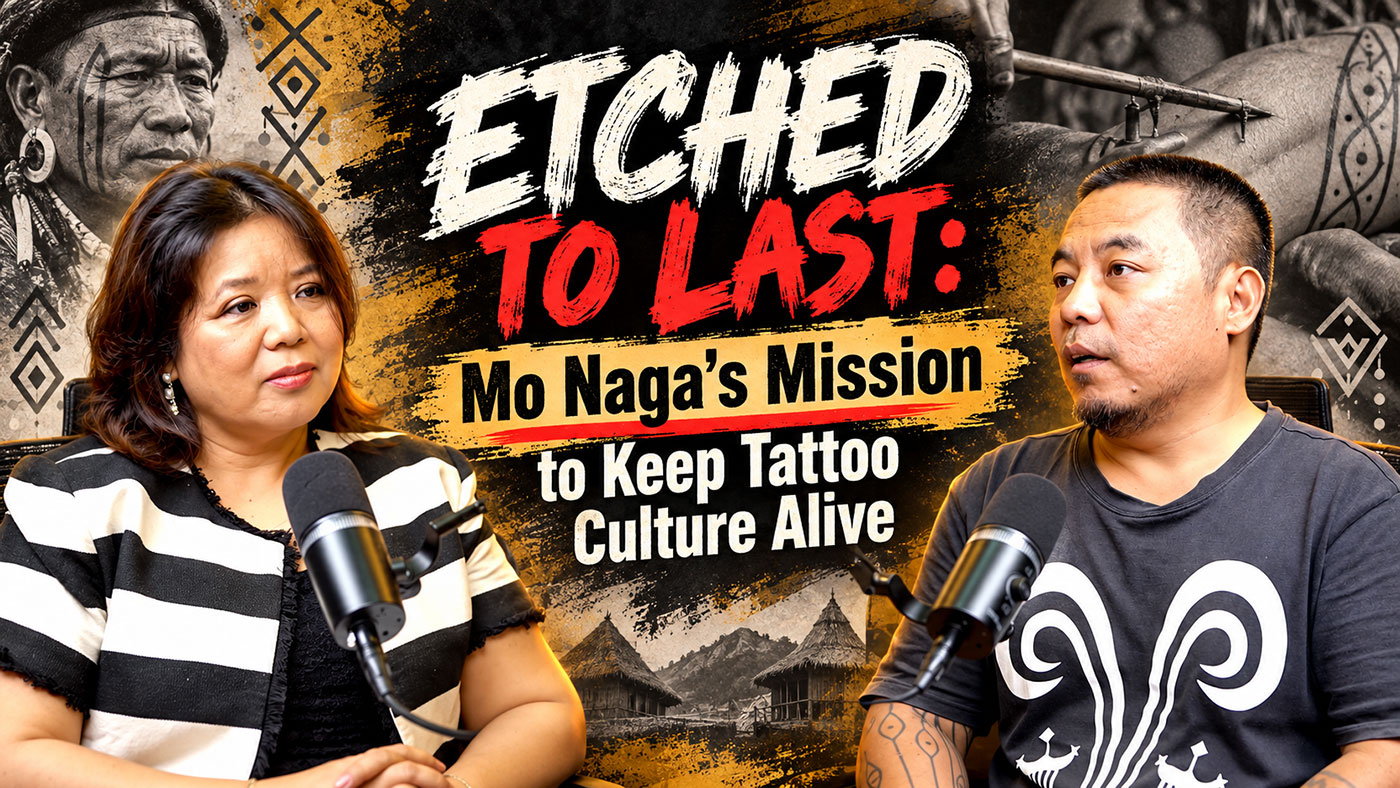
Northeast Stories is proud to present the debut series of its new podcast, Culture Keepers—a space dedicated to honouring the guardians, artists, and visionaries preserving the living heritage of the region.
Leading this inaugural journey is Mo Naga (born Moranngam Khaling), an ethnic Uipo Naga tattoo artist from Manipur whose life’s work exists at the captivating intersection of contemporary art, indigenous identity, and ancestral revival.
A fashion design graduate from the prestigious National Institute of Fashion Technology (NIFT) in Hyderabad, Mo began tattooing professionally in 2008, establishing his first studio in Delhi. His craft quickly gained national and international acclaim, earning him a role as a brand ambassador for Lee Jeans and a featured profile in Yale University Press’s definitive volume, The World Atlas of Tattoo.
Yet, Mo Naga’s trajectory is far more profound than that of a mainstream artist achieving global success. Over time, he turned his lens inward, gazing back at his own cultural lineage to confront an urgent question: What happens when a living ancestral tradition begins to fade into obscurity—and can art resurrect it without diluting its sacred meaning?
To grasp the depth of Mo’s mission, one must first understand the sacred place of tattooing within traditional Naga life.
For generations across various Naga communities, body markings were never mere ornamentation or aesthetic trend. At a time when written script was not the primary record keeper, the skin itself functioned as a living archive. Tattoos served as permanent records of identity, clan lineage, social standing, rite of passage, and personal achievement. The body was a visual history book—its marks communicating stories that could be read instantly by the community, carrying collective memory across time.
These markings also carried profound spiritual weight. In traditional Naga cosmology, physical tattoos were believed to endure beyond mortality, remaining etched upon the soul so that ancestors could recognize one another in the afterlife. The permanence of the mark gave it a significance that far transcended individual self-expression.
Throughout the twentieth century, however, this rich visual language faced a sharp decline. The rapid spread of Christianity, shifting social hierarchies, the end of headhunting practices, modern education, and the influx of global pop culture steadily eroded the traditions that once gave these tattoos their purpose. What had been an intimate, living pillar of community life was suddenly at risk of vanishing into static museum exhibits and dusty historical texts.
Refusing to let this legacy slip away, Mo Naga has dedicated himself to breathing new life into these sacred art forms, not merely as historical artifacts, but as evolving practices for the modern world. Today, he is taking this cultural restoration a visionary step further by building a tattoo village in Manipur. Conceived as a living library, this space is designed to serve as a hub for cultural preservation, artistic exchange, and indigenous heritage, where the ancient stories written on skin can once again be honoured, taught, and passed down to future generations.